A business plan appendix is the section at the end of a business plan that holds the supporting documents a reader may want to check, such as resumes, financial statements, tax returns, leases, licenses and market research. The body of the plan summarizes, and the appendix holds the proof.
- Home
- Leading Teams
- Business Plan Template
- Business Plan Appendix
Business Plan Appendix: What to Include, With Examples and a Checklist
A business plan appendix is the back section of your plan where the supporting documents live: the resumes, financial statements, leases, licenses and research that prove what the rest of the plan claims.

The body of your plan tells a lender what you intend to do. The appendix shows them you can back it up with well documented research that goes deeper than what is needed on the key sections of your business plan.
One of the important details a reader might ask about your business plan is, "Where did you learn about this fact?" or "What is your primary source that will back up this statement, and do you have a secondary source?" Your sources provide excellent detail and should be organized and included in the business plan appendix.
The truth is that most of your readers will never delve into the appendix. The ones who do are usually the ones deciding whether to fund the business, and they will read it with great interest to verify your numbers. That's why a thin appendix can sink a strong plan, and a well-organized one can carry a business plan funding request over the finish line.
Jump To: What Is an Appendix | What to Include | Sample Appendix | How to Organize | Checklist | What to Leave Out | Who Sees It | What Lenders Check | Your Conclusion | Common Mistakes | FAQ
What Is a Business Plan Appendix?
A business plan appendix is a section at the end of a business plan that holds the supporting documents a reader may want to check, such as resumes, financial statements, tax returns, leases, contracts, licenses and market research. The body of the plan summarizes and provides a solid narrative to support the business plan; the appendix provides the documented proof.
Some plans call it "appendices," plural, because each document is its own lettered exhibit. Both terms mean the same section.
"You need a plan to build a house. To build a life (or a business), it is even more important to have a plan or goal."
- Zig Ziglar
Every section of your business plan is written to be short. Your executive summary fits on a page or two, and your company description names the owner's experience in a few paragraphs. The appendix is where the full detail goes, so a reader who wants to see the owner's resume, or the lease behind the rent figure in your monthly expenses, can turn to the back and find all the nitty-gritty details.
If you're using our Business Plan Template, the appendix is the last section, and four earlier sections already point to it: your management team section sends resumes there, operations sends job descriptions, the funding request sends your full start-up cost table, and the financials send your complete statements. As you can tell, the appendix is quite popular.
What to Include in a Business Plan Appendix
The simplest way to decide what goes in your appendix is to reread your plan and mark every claim a skeptical reader might ask you to prove. Each mark is an appendix item. Most plans end up drawing from the same five groups.
About you and your team
- Resumes for each owner and key manager
- Job descriptions for the roles you'll hire in the first year
- An organization chart, if more than a handful of people report to someone other than the owner
Financial documents
- Full financial statements: the cash flow projection, income statement and balance sheet your plan summarizes. The Business Plan Financials Workbook builds all three from three input tabs.
- Your detailed start-up cost table
- A personal financial statement for each owner
- Business and personal tax returns for the years your lender asks for, usually the last two or three
- Business and personal credit reports
Legal and ownership documents
- Business licenses and permits
- Articles of incorporation, a partnership agreement or an LLC operating agreement
- Leases for your space, vehicles or major equipment
- Signed contracts, letters of intent and major purchase agreements
- Insurance and bonding certificates
- Trademarks, patents or copyrights you've filed
Market research
- Survey results and customer interview notes you drew on in your market analysis
- Industry data you cited, with the source
- Letters of reference from customers, suppliers or partners
Operations
- Photographs of your location, product or equipment
- Floor plans, site maps or delivery route maps
- Supplier price quotes that back up the costs in your plan
You won't need all of the above items. For instance, a home-based bookkeeper has no lease or floor plan to include. But restaurant is definitely going to need to provide proof of having a health permit and a floor plan before a lender will take the plan seriously. Include anything that is required by your business to operate effectively and legally. Anything on the above list that doesn't apply, leave it out.
A Sample Business Plan Appendix: Evergreen Office & Medical Cleaning
Evergreen Office & Medical Cleaning is the same business you'll find in our Business Plan Financials Workbook and mission statement worksheet. Sarah, the owner, cleans offices and medical suites in the evenings with two part-time cleaners, It takes $39,000 to open, including a used van, cleaning equipment and a cash cushion for the early months. Sarah is putting in $27,000 of her own savings, and her plan asks a lender for the other $12,000.
Her appendix included seven exhibits. The note under each exhibit names the claim that is in her plan and provides the related proof, which is the test every appendix item should pass.
EVERGREEN'S APPENDIX
Seven exhibits, in the order the plan refers to them.
A
Appendix A: Sarah's resume
Backs up the management section: the cleaning and supervisory experience she brings to running her own crew.
B
Appendix B: Full financial statements
Backs up the financial section: the first-year cash flow projection, income statement and balance sheet from the Business Plan Financials Workbook, month by month.
C
Appendix C: Start-up cost table and quotes
Backs up the funding request: the $39,000 it takes to open, line by line, with the dealer quote on the $18,000 used van and supplier quotes on $6,000 of equipment.
D
Appendix D: Personal financial statement and tax returns
Backs up her ability to repay the $12,000 loan: her last two years of personal tax returns and a personal financial statement showing the savings behind her $27,000.
E
Appendix E: Business license, insurance and storage lease
Backs up the operations section: the license she operates under, the liability insurance and bonding medical practices ask to see before they hand over a key, and the $150-a-month storage lease.
F
Appendix F: Two letters of intent
Backs up the sales forecast: two practice managers confirming they plan to sign on in her first month.
G
Appendix G: Target practice list
Backs up the market analysis: the small medical practices in her service area with two to six exam rooms, the accounts her forecast grows into.
Notice what isn't included. Sarah is purposely selective and doesn't include the equipment brochures she collected, a copy of her cleaning checklists or the business cards she had printed. None of them back up a key claim in her business plan that a lender would care about.
How to Organize and Label Your Appendix
A reader should be able to find any document in under a minute. Four simple steps will ensure each document is easily found.
- Letter each document as an exhibit. Call them Appendix A, Appendix B, Appendix C and so on, or Exhibit A, B and C. Pick one style and use it throughout.
- Put a one-page contents list at the front of the appendix. List each letter, the document's name and its page number.
- Point to the appendix from the body of your plan. When your funding request mentions the used van, add "(See Appendix C for the full start-up cost table.)" Every exhibit should be referenced at least once, and an exhibit nobody points to is a sign it doesn't belong in the appendix at all.
- Order the exhibits the way the plan reads. If your team section comes before your financials, the team's resumes will come before the financial statements. A reader moving front to back should be able to identify each supporting document in the order they read about it in the business plan.
Keep the formatting plain and simple. Scan signed documents so they're legible, and use the same page size and orientation as the rest of the plan. A lender flipping between pages that are scanned sideways or upside down loses patience quickly.
Business Plan Appendix Checklist
Copy this checklist into your plan file and cross off each item as you gather it. Items you don't need can stay unchecked; the point here is to be thoughtful and decide based on what will be supportive of claims made in the plan.
What to Leave Out, and What to Blank Out
Before placing any item in the business plan appendix, confirm that it's 100% accurate and relevant to the reader. Too often what people include fails that test.
Leave out anything that doesn't back up a specific claim: brochures, general articles about your industry, every purchase quote for equipment you collected when only the one you chose matters, and drafts of documents that aren't final yet. An appendix that runs 60 pages when 20 would suffice tells a lender you couldn't decide what mattered.
Then blank out what a reader doesn't need to see. Protect your personal information. Tax returns, credit reports and bank statements carry Social Security numbers, account numbers and dates of birth. Black them out on every copy except the one going to the lender who has asked for them in full, and even then, ask whether they want them attached to the plan or sent separately through their secure portal.
Who Sees Your Appendix
The information in your appendix should be treated as confidential, because it shows a reader things about you and your business that you'd never want shared or published.
Your personal finances, your lease terms, your supplier pricing and your customers' names are all highly sensitive information, so take a few simple steps to protect them.
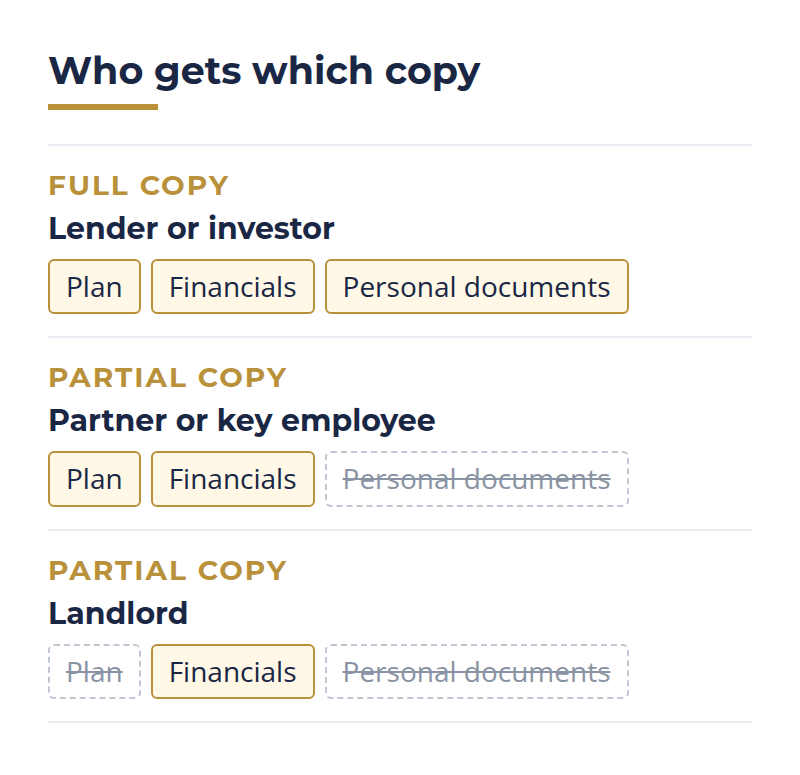
That means not every reader gets the same plan. A lender or investor weighing a funding decision gets the full plan with the complete appendix. A business partner or a key employee may need the plan but not your personal tax returns. A landlord considering your lease might need your financial statements and nothing else. Consider these documents available on a need-to-know basis only.
Keep a master distribution list: who received a copy, which version, and the date. It takes five minutes to set up in a spreadsheet, and it pays off twice. You'll know exactly who has seen your personal financial statement, and when you update the plan, you'll know who needs the new version.
"Facts are stubborn things; and whatever may be our wishes, our inclinations, or the dictates of our passions, they cannot alter the state of facts and evidence."
- John Adams
What a Lender Looks for in the Appendix
Every loan officer has their own approach when doing a first pass of a new business plan. One loan officer may immediately take a quick review of your appendix to check that the plan appears to be well supported. Many lenders go to the appendix immediately after reading the executive summary and funding request as they want to now see your financial statements.
A primary question the lender needs answered is whether or not you will be able to repay the loan. Your personal financial statement and tax returns show what you own, what you owe and what you've earned, which tells them whether you can carry the loan and properly secure it with a personal guarantee. Lenders who make SBA loans usually ask for the personal financial statement on SBA Form 413.
Next they check that the numbers match. Sarah's funding request lists the used van at $18,000, so the dealer quote in her appendix had better say $18,000 too. Her monthly expenses show $150 for storage, and the storage lease should show the same figure. A mismatch of a few hundred dollars won't kill a loan on its own, but it sends the loan officer back through every other number in your plan looking to see if there are additional errors.
Then they read the resumes, looking for experience in the business you're proposing. An owner who managed a cleaning crew for six years before starting one reads very differently from an owner who has never done this type of work before.
Most of what a lender will ask for comes out of your business plan financials, so build those first and let the appendix hold the full statements.
The Appendix and Your Conclusion
Your business plan's conclusion is a short, personal statement to the reader: your commitment to making the business work and why investing in it is a good decision for them. Write it after everything else, including the appendix, because by then you know your plan inside and out, and you specifically know what claims your documentation supports.
Don't confuse the personal statement with the executive summary. The executive summary opens the plan and tells the reader what they're about to learn. The conclusion closes it and tells them why you're the person to make it happen.
Before you write the conclusion, go back to the beginning and finalize your executive summary, since the numbers and claims you settled while building the appendix may have shifted since you originally drafted it.
Common Mistakes in a Business Plan Appendix
Most weak appendices come from the same few mistakes, and each is easy to catch before you send the plan.
- Padding it with too many documents. Brochures, articles and every purchase quote you collected can bury the documents that matter.
- Numbers that don't match the plan. The rent on the lease, the price on the equipment and the totals on your statements should match the body of your plan to the dollar.
- No contents list or labels. Make sure the documents are well organized. A reader who can't find the lease in under a minute stops looking.
- Exhibits nobody refers to. If no section of your plan points to a document, ask whether it needs to be included.
- Unblanked personal information. Social Security and account numbers don't belong on a copy going to a partner or employee. Share only on a needs-to-know basis.
- Out-of-date documents. A tax return from four years ago or an expired license raises more questions than it answers.
- Losing track of copies. Without a distribution list, you won't know who has your business plan and personal information.
Frequently Asked Questions
Questions we get asked most often about the business plan appendix.
Click on the (+) sign below to expand each question. Click the (-) sign to collapse it again.
What is a business plan appendix?
What goes in a business plan appendix?
A business plan appendix is the section at the end of a business plan that holds the supporting documents a reader may want to check, such as resumes, financial statements, tax returns, leases, licenses and market research. The body of the plan summarizes, and the appendix holds the proof.
Does every business plan need an appendix?
A plan written only for your own team may not need one. A plan going to a lender or investor almost always does, because they'll ask to see the documents behind your numbers.
How long should a business plan appendix be?
Long enough to hold the documents your plan relies on. For a small business that's often 10 to 25 pages. An appendix that runs longer than the plan itself is usually padded.
How do you label a business plan appendix?
Letter each document as an exhibit (Appendix A, Appendix B and so on), put a one-page contents list at the front with each letter, title and page number, and refer to each exhibit by its letter from the body of your plan.
Should financial statements go in the appendix or the financial section?
Both. Put the summary tables and key figures in your plan's financial section, and put the complete month-by-month statements in the appendix. The reader gets the picture from the body and the detail from the back.
Is it appendix or appendices?
Appendix is the singular and appendices is the plural. Many plans title the section "Appendices" because it holds several lettered documents. Either title is correct.
What should you leave out of a business plan appendix?
Anything that doesn't back up a specific claim in your plan, such as brochures, general industry articles, quotes you didn't use and draft documents. On copies going to anyone other than your lender, blank out Social Security numbers, account numbers and dates of birth.
Who should get a copy of the appendix?
A lender or investor gets the full appendix. A partner or key employee may get the plan without your personal financial documents, and a landlord may need only your financial statements. Keep a distribution list of who received which version and when.
What's the difference between the appendix and the conclusion?
The conclusion is a short statement explaining your commitment to the business and why it's a sound decision for the reader. The appendix follows it and holds the supporting documents. Write the conclusion last, once the appendix is assembled.
More Business Planning Tools & Information




Richard Gorham has led teams in financial services for more than 30 years, from retail branches and operations to investments and insurance, and he still leads a team today.
He founded Leadership-Tools.com in 2002 to give managers free, practical tools like the ones he used in his various leadership roles. Every tool here has been used in a real workplace and comes with a filled-in example you can follow.

Contact Information:
phone
(503) 970-9777
Email Customer Service
helpsupport@leadership-tools.com
Email Richard
richard@leadership-tools.com

By Richard Gorham
Leadership-Tools.com
2879 Riverwalk Loop, Eugene, Oregon, 97401
Copyright (c) 2002 - 2026 All Rights Reserved