A Life Balance Wheel is a specific assessment tool. "Life balance" advice is the broad guidance you find everywhere: sleep more, set boundaries, make time for what matters. Useful, but vague. The wheel turns that general idea into something you can actually see and act on. You rate each area of your life, plot the scores, and the shape shows you exactly where to focus first instead of trying to fix everything at once.
- Home
- Leading Self
- Life Balance Success Wheel
Life Balance Wheel Assessment (Success Wheel)
Achieving Life Balance is a common goal. As we grow older and life gets busier with family, work and community commitments it's not surprising so many people wake up one day realizing that their life is not balanced, and they decide that something has to change. Use our Life Balance Wheel assessment tool to make sure you lead a balanced life.
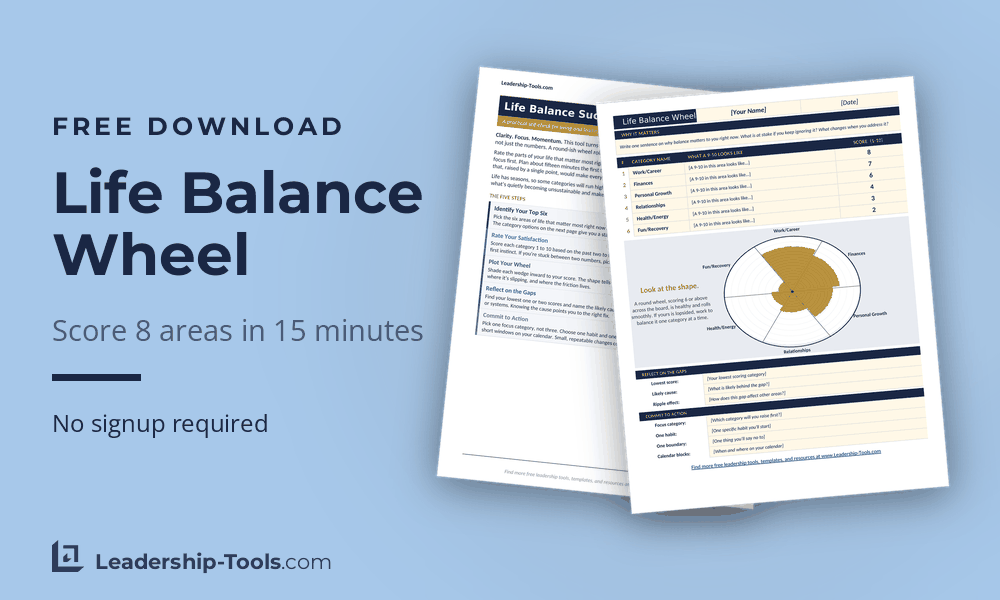
Download Life Balance Wheel Template:
Understanding that change needs to take place in certain areas of your life is the first step toward a more balanced and successful tomorrow.
So what's the second step? What exactly should you do next?
You need a simple tool that will help you to identify the most important areas of your life and clearly measure how effective you are in each key category.
Only once you go through that process can you begin to identify how to address the problem areas in an effort to create a more well-rounded life experience.
Our free tool, the Life Balance - Success Wheel, has been designed to do just that. Sections of the wheel represent your most important life categories. By measuring your collective life categories on the success wheel, you'll create a visual that depicts how balanced your life is.
Jump To: What Is Life Balance Wheel |5 Steps to Life Balance | Interpret Your Results | Choose Your First Focus | 7-Day Reset Plan | Example 1: Meet Jordan | Example 2: Ben Carter | FAQ | Get Updates Free | Download Tool
What Is a Life Balance Wheel?
A Life Balance Wheel is a quick life balance self-assessment that asks you to rate the most important areas of your life on a simple scale (for example, 1–10). You plot those scores on a wheel to create a visual snapshot of your current balance.
Why use a wheel to display results? Because it supports visual learners by providing a quick snapshot of the overall "balance" in your life, based on your current ratings. A wheel that’s mostly round “rolls” more smoothly, which means ratings are balanced. However, a wheel with one or two deep dips is lopsided and tends to create friction. Stress, fatigue, poor focus, or that feeling that you’re not meeting expectations, can be indicative you need to pay more attention to an important life category.
Common alternate names to Life Balance Wheel may include:
- Wheel of Life assessment
- Life balance assessment wheel
- Life balance wheel worksheet
5 Steps to Complete the Life Balance Wheel Assessment
As a leader, or someone who aspires to be a leader, your first goal should be to effectively lead yourself. You must set an example for others by leading a well-balanced, happy and successful lifestyle. Otherwise, anyone who is paying attention won't have any reason to follow you.
Here are the steps required in our Life Balance Wheel exercise:
Step 1: Choose Your Categories (or use the defaults)
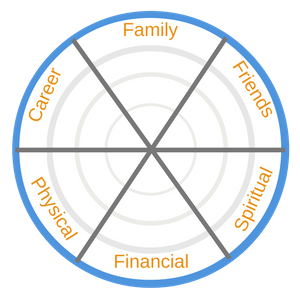
Start with 6–8 categories. Use what fits your life and season. For leaders and solopreneurs, the following categories are common:
- Work/Career
- Health/Energy
- Relationships/Family
- Finances
- Personal Growth/Learning
- Fun/Recovery
- Community/Contribution
- Environment/Home
How to choose the right categories (2–3 minutes):
- Pick the categories that truly drive your quality of life and performance right now.
- Rename any category so it matches your reality (this increases honesty when you score). Example: “Work/Career” → “Business Growth” (solopreneur) or “Leading My Team” (manager)
- Combine categories if they overlap too much. Example: If “Community” and “Contribution” feel the same, merge them.
- Add one category if your situation demands it. Examples: “Parenting,” “Spiritual Life,” “Mental Health,” “Marriage,” “Side Hustle,” “Social Life”
Step 2: Define What a “10” Means (briefly)
"Take time to self-assess, then make time to self-improve.”
A “10” isn’t “perfect.” It’s your personal definition of “this area is strong and sustainable for me right now.”
Why this matters: If you don’t define a 10, you may mistakenly score based on mood, comparison to others, or unrealistic expectations. A quick definition makes your scoring consistent and repeatable.
How to do it (60–90 seconds total):
- Pick 1–2 categories you care most about (or tend to overthink).
- Finish this sentence for each: “A 10 in [category] means…”
- Keep it measurable and sustainable (what you can maintain most weeks, not during a vacation week).
Good “10” definitions are:
- Specific: includes 1–3 clear signals
- Realistic: doable in your current season
- Sustainable: doesn’t require constant overwork
Quick Examples:
- Health/Energy: “I sleep 7+ hours most nights, move 3x/week, and have steady energy most afternoons.”
- Relationships/Family: “I’m present at least 4 nights/week, and I have one meaningful 1:1 conversation weekly.”
- Work/Career (leader): “I’m proactive on priorities, not constantly firefighting, and I end most days with a clear plan for tomorrow.”
- Finances: “Bills are covered, I’m saving monthly, and money stress is low most weeks.”
- Fun/Recovery: “I have at least one unplugged block weekly and I feel genuinely refreshed afterward.”
Step 3: Score Each Category Honestly (1–10)
Goal: capture “current reality,” not “what you wish were true.”
How to score quickly and accurately:
- Go category by category in order.
- Use your first instinct, then move on.
- Ask one grounding question per category: “Over the past 2–4 weeks, what does this look like most of the time?”
Use this simple scoring guide:
- 9–10: Strong and stable; you’re maintaining it well.
- 7–8: Good, but could slip under pressure.
- 5–6: Mixed; sometimes okay, sometimes not.
- 3–4: Weak; it’s affecting other areas.
- 1–2: Critical; urgent attention needed.
If you’re unsure between two numbers:
- Choose the lower number. It’s usually closer to reality and more useful for action.
Step 4: Plot Your Scores to Create the Wheel
This is where the assessment becomes visually obvious.
How to plot your Life Balance Wheel (simple):
- Find each category segment on the wheel.
- Mark a dot at your score level for that segment (e.g., 6/10).
- Repeat for every category.
- Connect the dots all the way around to form your “wheel” shape.
- Lightly shade the area inside the connected shape (optional, but it makes patterns pop).
What to look for immediately:
- A smooth, round-ish shape = fewer friction points.
- One deep dip = a likely “drag point” that affects everything else.
- Multiple low areas = you may be overloaded or missing recovery time.
Important note:
A perfectly round wheel isn’t the goal. A functional wheel is. Most leaders choose to be intentionally “higher” in Work/Career during certain seasons. That's fine as long as you are doing that purposely, just don’t let that season quietly become your permanent default.
Step 5: Circle the lowest 1–2 categories and pick one focus
This step turns insight into action.
How to choose your focus without overwhelm:
- Circle your lowest score.
- Circle your second-lowest score.
- Pick ONE of those as your focus category for the next 7–30 days.
How to decide which of the two to focus on:
Choose the one with the biggest “ripple effect.”
Ask:
- “If I raise this by 1 point, what else improves automatically?”
Examples:
- Improving Health/Energy often improves Work, Relationships, and Fun.
- Improving Finances can reduce stress and improve sleep and presence.
- Improving Relationships can improve mood, motivation, and resilience.
Keep the target small and measurable:
- Aim: raise that category by +1 point in 30 days (not +5).
- Pick one habit + one boundary (or one habit + one system).
"Leadership is learning by doing, adapting to actual situations. Leaders are constantly learning from their errors and failures."
- Claude Meyer
How to Interpret Your Life Balance Wheel Results
Your wheel shows your current reality across the life areas that most affect performance, relationships, and wellbeing. Don’t aim for a perfectly round wheel. Recognize that life has seasons.
"To learn, grow and improve yourself, you must be willing to accept that there are things today you are not doing well."
For example, you may naturally rate yourself lower in relationships when work dictates more of your time. Sales roles often have natural peak times of the year when sales opportunities are more readily available.
The goal is to spot what’s becoming unsustainable and make one high-leverage adjustment. Treat low scores as signals, not failures.
Next, you’ll identify your lowest 1–2 areas, pinpoint the likely cause (time, energy, boundaries, or systems), and choose one focus you can improve starting this week.
Look for Your “Lowest 1–2” Scores First
Those are often your biggest leverage points. Raising a 2 to a 4 usually improves life more than raising an 8 to a 9.
Notice the biggest gaps (high vs. low)
A common pattern for leaders is:
- Work/Career is high
- Health/Energy or Relationships is low
That gap is a sustainability warning sign.
Identify the real cause: Time, Energy, Boundaries, or Skills
Ask: “What’s making this score low?”
- Time: “My schedule is overloaded.”
- Energy: “I’m depleted; even simple tasks feel heavy.”
- Boundaries: “Other people’s urgency runs my week.”
- Skills/Systems: “I don’t have a plan, routine, or process.”
Choose a single, measurable improvement
A good target is: “Raise this category by 1 point in 30 days.”
Once you’ve identified your lowest 1–2 areas and the likely cause (time, energy, boundaries, or systems), don’t overanalyze the picture, just use information to make a decision.
Choose one category to improve first, aim for a realistic +1 point over the next 30 days, and take one small action this week. The goal isn’t a perfect wheel; it’s steady, sustainable progress you can repeat.
Choose Your First Focus (A Quick Decision Tool)
If you’re not sure what to work on first, use this “choose-your-bottleneck” mini guide.
If the problem is TIME
Focus on subtraction.
- Cancel, pause, or delegate one recurring commitment
- Reduce “open loops” (unmade decisions) that drain attention
- Batch small tasks into one block instead of constant switching
If the problem is ENERGY
Focus on recovery.
- Improve sleep routine by one change (consistent wake time, earlier screen cutoff, etc.)
- Add 10–20 minutes of movement 3x/week
- Schedule one true “off” block (no phone, no work)
If the problem is BOUNDARIES
Focus on one script and one rule.
- Script: “I can’t do that today. I can do X by Thursday.”
- Rule: No meetings before a specific time, or no work after a specific time (choose one)
If the problem is SKILLS/SYSTEMS
Focus on structure.
- Weekly planning ritual (15 minutes)
- Daily “Top 3” priorities
- Time-block one deep-work session
Your 7-Day Life Balance Reset Plan (Simple and Realistic)
Here we provide a practical bridge between “assessment” and “change.” Use it immediately after you complete your Life Balance Wheel worksheet.
This 7-day life balance reset plan turns your Life Balance Wheel assessment into action you can actually follow. It’s designed for busy leaders and solopreneurs who don’t need a complicated overhaul, just a small, controlled reset that creates momentum.
Keep the bar intentionally low. Your goal this week isn’t to “fix” life balance; it’s to prove to yourself that change is possible with realistic steps, even in a full schedule.
Day 1: Pick Your One Category
Choose one category to focus on for the week: either your lowest score or the category with the biggest ripple effect (often Health/Energy, Relationships, or Fun/Recovery).
Write the category name at the top of your plan and set a simple target like “+1 point in 30 days” so you’re aiming for progress, not perfection.
Day 2: Choose one habit and one boundary
Pick one small habit that strengthens your focus category, and one boundary that protects it.
Example: for Health/Energy, your habit might be “walk 15 minutes after lunch,” and your boundary might be “no work messages after 7 pm.” Keep both choices easy enough that you can do them even on a stressful day.
Day 3: Schedule two small blocks
Put two short blocks on your calendar this week (even 20–30 minutes) that directly support your focus category. Treat them like real appointments, because if it isn’t scheduled, you'll be more likely to forget it or consider it as "optional" - and optional rarely happens when you’re busy.
Days 4–6: Follow the plan at “minimum viable” level
Do the habit and hold the boundary at the smallest level that still counts. If you planned a 15-minute walk, do 10. If you planned “no work after 7,” aim for two nights this week.
Consistency matters more than intensity; your goal is to build a streak, not to impress yourself.
Day 7: Review in 10 minutes
Look back quickly and objectively: what worked, what didn’t, and what got in the way?
Decide one adjustment for next week (make it easier, clearer, or better-timed), then keep the same focus category for another week if it’s still your best leverage point.
At the end of these 7 days, you should have one clear win, one clearer boundary, and a better sense of what actually moves the needle for your life balance.
Keep what worked, adjust what didn’t, and repeat for one more week before you re-score your Life Balance Wheel.
Remember, small, steady changes compound fast.
Example 1: A Frontline Manager (or Solopreneur) Life Balance Wheel
Jordan is a frontline operations manager at a growing service business. The last few months have been nonstop, covering shifts, solving customer issues, and trying to be the “steady one” for the team. As a result, Jordan’s work score is high, but sleep and recovery have quietly slid.
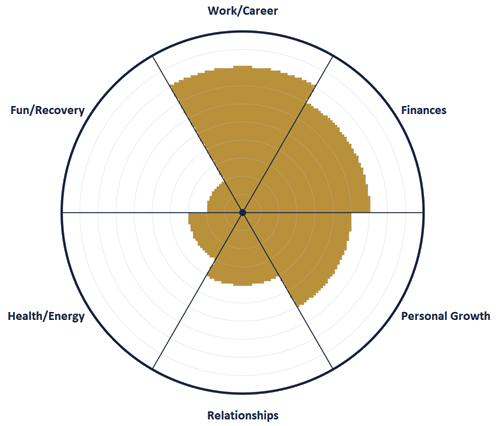
Starting Scores (example)
- Work/Career: 8
- Finances: 7
- Personal Growth: 6
- Relationships: 4
- Health/Energy: 3
- Fun/Recovery: 2
Interpretation
Jordan’s wheel will “bump” because Recovery and Energy are low. The bottleneck is mostly Energy (and a packed schedule that doesn’t protect downtime).
One Focus Category
Choose Health/Energy (raise from 3 → 4 in 30 days)
Two Realistic Actions
- Habit: Walk 15 minutes, 3x/week (calendar it)
- Boundary: End work at a fixed time two nights/week (communicate it)
Result
Within a couple of weeks, Jordan feels more patient in tough conversations and sharper in day-to-day decisions. He's experienced small energy gains that noticeably improve leadership performance.
Example 2: Ben Carter, Operations Managers
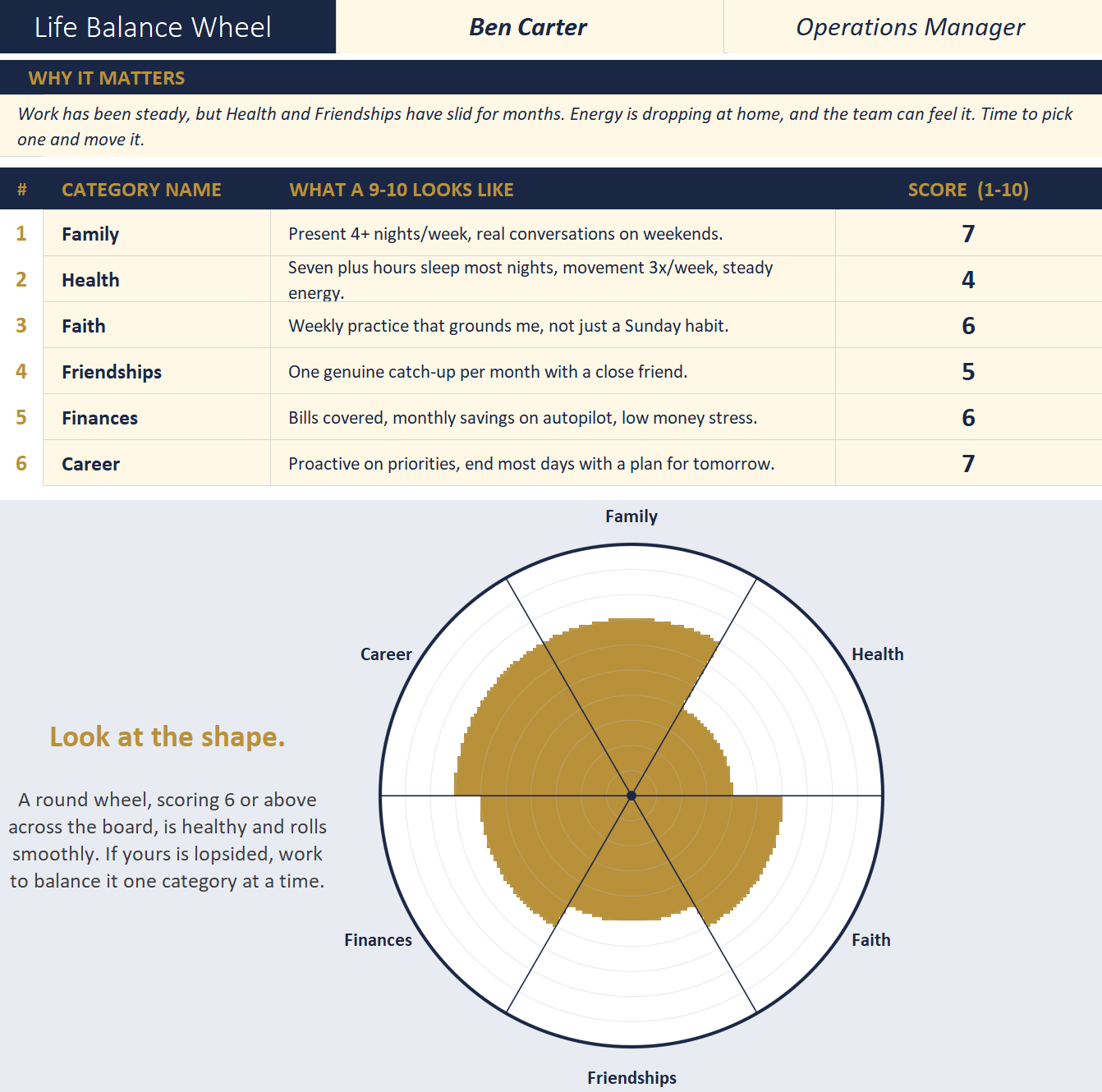
In the Life Balance Wheel excel spreadsheet, we've provided a personal example and a career example. The personal example for Ben Carter, an Operations Managers.
Shown below is how Ben rating his life categories. Additionally, he's defined what a 9-10 score looks like to him.
FAQs (Life Balance Wheel - Life Assessment)
Click on the (+) sign below to expand each question. Click the (-) sign to collapse it again.
What is the difference between a Life Balance Wheel and “life balance” advice?
What categories should I use on my Life Balance Wheel?
Use categories that reflect your actual life and responsibilities, not a generic list. Start with 6 to 8, and rename them so they feel true to you. A solopreneur might track "Business Growth" where someone else tracks "Career." A parent might add "Parenting" or "Marriage." The wheel works best when the labels match the life you're actually living, because that's what makes your scores honest.
How often should I do a life balance assessment?
Many people redo it quarterly, which lines up well with the natural rhythm of work and seasons. At minimum, do it once a year, and anytime you feel sustained stress, fatigue, or a major life change like a new role, a move, or a shift in family responsibilities. The real value comes from comparing wheels over time. One snapshot tells you where you are; a series of them shows you which direction you're trending.
What is a “good” score?
A "good" score is one you can sustain. A 10 that requires burnout to maintain isn't truly balanced, it's borrowed against next month. Aim for steady, repeatable scores rather than perfect ones. A consistent 7 you can hold without running yourself down beats a 9 you can only reach by sacrificing sleep, relationships, or your health. Sustainability is the real measure here, not the number itself.
What if my wheel looks balanced but I still feel stressed?
This happens more often than you'd expect, and it's worth paying attention to. A wheel can look even while something underneath is still off. Stress can come from overload across the board, a lack of genuine recovery time, or priorities that aren't clear even when no single category is screaming for help. Use the "Time / Energy / Boundaries / Skills" check from the interpretation section to find the root cause. Often the issue isn't one low score, it's that every area is running a little too hot at once.
Can I use the Life Balance Wheel with my team or family?
Yes, and it works well as a shared exercise. Have each person score their own wheel privately first, then talk through what they're comfortable sharing. For a team, it opens an honest conversation about workload and burnout before either becomes a real problem. For a family, it surfaces where people feel stretched before resentment has a chance to build. The privacy-first step matters, though. People score more honestly when they know they control what gets shared.
How is the Life Balance Wheel different from the Wheel of Life?
They're essentially the same tool under different names. "Wheel of Life" is the term you'll see in coaching circles; "Life Balance Wheel" is the same visual self-assessment. Whatever it's called, the value is identical: rate your key life areas, plot them, and use the shape to decide where to focus first. If you've done a Wheel of Life exercise with a coach before, this will feel familiar, and you can use our template to do it on your own anytime.
How many categories is too many?
More than eight usually works against you. The point of the wheel is clarity, and once you're tracking ten or twelve areas, the picture gets noisy and every category starts to feel "kind of low." If you find yourself wanting more than eight, look for overlap and combine. "Social Life" and "Friends" are probably one category. "Health" and "Fitness" often are too. A tighter wheel gives you a sharper read and an easier decision about where to start.
Do I have to improve my lowest score first?
Not always. Your lowest score is the obvious candidate, but the better question is which area has the biggest ripple effect. Sometimes raising a moderate score lifts everything around it. Improving Health/Energy, for example, often improves Work, Relationships, and Fun at the same time, because energy feeds all of them. Pick the one point of improvement that would quietly make the rest of your wheel easier to raise, even if it isn't technically your lowest number.
What should I do after I finish my wheel?
Pick one focus category, choose one small habit and one boundary that protect it, and run the 7-Day Reset Plan on this page. That's the whole loop. Don't try to fix the entire wheel at once, that's the fastest way to abandon it. Raise one category by a point over 30 days, then re-score and pick your next focus. Small, repeatable progress is what actually changes the shape of your wheel over time.
Download Life Balance Success Wheel Tool
Want the entire leadership tools library? Subscribe to our free newsletter and we'll send you a link to every tool on this site, all on one page, sorted by leadership phase. Every tool is free to download on its own page. The library just puts them in one place. Plus, you'll never miss out on updated or new tool announcements.
Your privacy is important to us. We never share or sell email addresses.
Leadership Tools Newsletter
Subscribe Free - See All Tools on One Page - Get New Tool Alerts
More Self-Leadership Tools




Contact Information:
phone
(503) 970-9777
Email Customer Service
helpsupport@leadership-tools.com
Email Richard
richard@leadership-tools.com

By Richard Gorham
Leadership-Tools.com
2879 Riverwalk Loop, Eugene, Oregon, 97401
Copyright (c) 2002 - 2026 All Rights Reserved