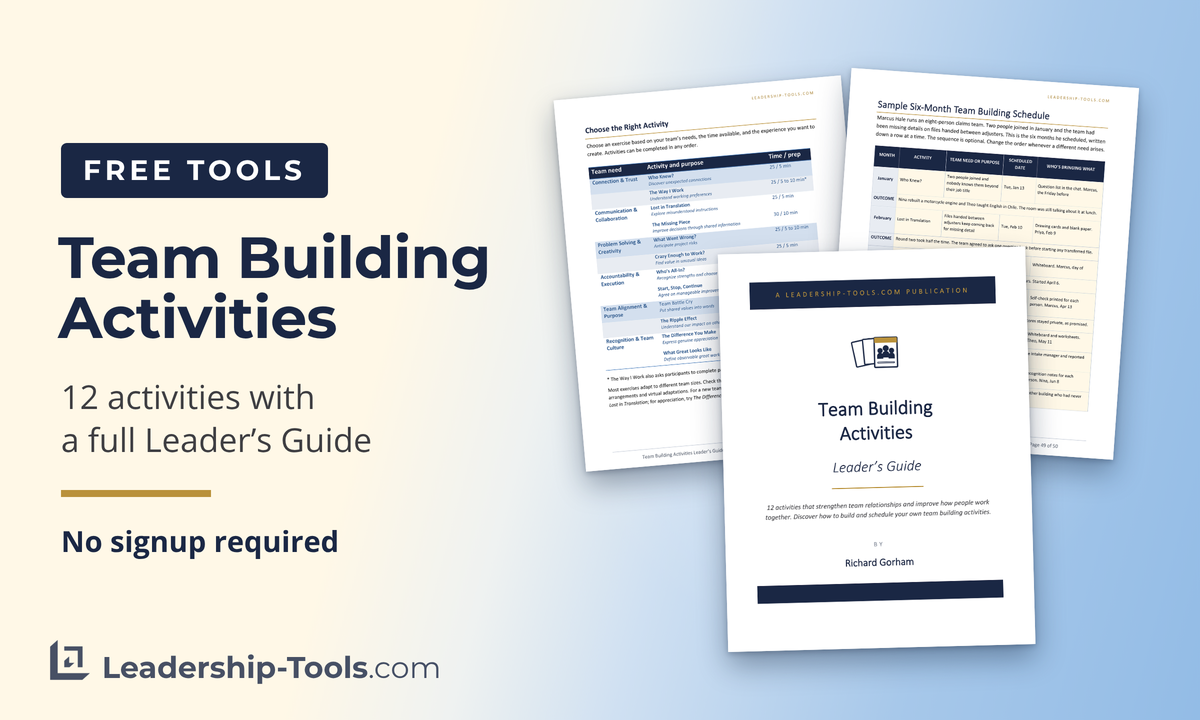
Free team building activities are short team building exercises a leader can run with their own team using printed pages from the guide and a whiteboard, with no paid facilitator. The 12 on this page take 25 or 30 minutes each, need 5 to 10 minutes of preparation, and come with timed steps and a worksheet in the free Leader's Guide.
- Home
- Leading Teams
- Free Team Building Activities
Free Team Building Activities for Work
Free team building activities give leaders an opportunity to bring people together, strengthen relationships, and improve how their teams work. And with a little preparation, you can create a meaningful experience in just 25 or 30 minutes during a regular team meeting. None of these activities needs a paid facilitator or anything you’d have to buy.
Sometimes 25 or 30 minutes during a regular team meeting is enough to help people connect, work through a challenge, or see a familiar situation differently.
Download Free Team Building Activities Leader's Guide
Our free Team Building Activities Leader’s Guide gives you 12 ready-to-run team building exercises organized around six common team needs. Some are simply fun ways to help teammates get to know each other. Others address communication, decision-making, accountability, team alignment, and recognition. Each activity includes preparation, step-by-step instructions, discussion questions, and facilitator notes.
Download the complete 50-page Leader's Guide to team building. It includes the supporting worksheets and activity cards, a section on designing your own exercise, and a six-month activity scheduler. Everything is free, and no signup is required.
Jump To: Choose an Activity | Connection & Trust | Communication & Collaboration | Problem Solving & Creativity | Accountability & Execution | Team Alignment & Purpose | Recognition & Team Culture | How to Lead an Activity | Build Your Own | Schedule Template | Example | Five Mistakes | More on Team Building | FAQ | Download Guide
Free team building activities at a glance
| Formats | PDF, Word, Google Docs |
| Ideal for | Supervisors, managers, and business owners who lead a team |
| Includes | Leader's Guide: 12 activities, a build-your-own planner, and a six-month scheduler |
| Takes | 25 or 30 minutes per activity, plus 5 to 10 minutes to prepare |
Not sure where to start?
| For a new team, start with Who Knew? People learn something about each other beyond their job titles. | |
| For communication problems, try Lost in Translation, a drawing challenge with two rounds. | |
| For appreciation, try The Difference You Make, then put next month's activity on the schedule. |
Choose a Team Building Activity by What Your Team Needs
Pick the activity by what your team is dealing with this month.
If three people joined in the spring and still only know their coworkers by job title, start with Who Knew? If work keeps getting handed off with the deadline or the person responsible missing, Lost in Translation or The Missing Piece will get the team talking about why. All 12 team building exercises are listed with their time, preparation and group size, each name jumps to its write-up, and you can run them in any order.
Every activity fits inside a regular team meeting. Preparation is separate from the activity time, so an activity listed at 25 minutes with 5 minutes of preparation means printing a page or picking a few questions the day before, and the meeting itself gives it 25 minutes. The Way I Work is the one activity that asks people to do something ahead of time. Each person fills in the first six prompts of a short worksheet before the meeting.
| Team need | Activity | What it does | Time | Prep | Group size |
| Connection & Trust | Who Knew? | Discover unexpected connections | 25 min | 5 min | Whole team |
| The Way I Work | Understand working preferences | 25 min | 5 to 10 min* | Pairs | |
| Communication & Collaboration | Lost in Translation | Explore misunderstood instructions | 25 min | 5 min | Pairs |
| The Missing Piece | Improve decisions through shared information | 30 min | 10 min | Groups of 4 to 6 | |
| Problem Solving & Creativity | What Went Wrong? | Anticipate project risks | 25 min | 5 to 10 min | Whole team |
| Crazy Enough to Work? | Find value in unusual ideas | 25 min | 5 min | Whole team | |
| Accountability & Execution | Who's All-In? | Recognize strengths and choose a way to grow | 25 min | 5 min | Whole team |
| Start, Stop, Continue | Agree on manageable improvements | 30 min | 5 min | Whole team | |
| Team Alignment & Purpose | Team Battle Cry | Put shared values into words | 30 min | 5 min | Whole team |
| The Ripple Effect | Understand our impact on other groups | 30 min | 5 min | Whole team, then small groups | |
| Recognition & Team Culture | The Difference You Make | Express genuine appreciation | 25 min | 5 min | Pairs |
| What Great Looks Like | Define observable great work | 25 min | 5 min | Groups of 2 or 3 |
* The Way I Work also asks each person to fill in part of a worksheet before the meeting.
Whole team activities work best with up to about 15 people. If your team is larger, break into smaller groups so more people can contribute. Pairs and small-group activities work with a team of any size, and every activity includes a virtual version.
Connection & Trust Activities
These two activities help teammates get to know each other beyond their job titles, and neither asks anyone to share more than they're comfortable with.
Who Knew?
Connection & Trust | 25 minutes | 5 minutes to prepare | Whole team, or groups of four to six on a large virtual team
People can work together every day and still know surprisingly little about the experiences, interests, and strengths their colleagues bring to the team. This lighthearted activity uncovers unexpected connections, gives everyone a chance to be heard, and reminds us that the person behind a job title has even more to offer.
Team members learn something new about one another and identify a connection they can build on. No scoring, personal disclosures, or required follow-up. The experience should feel like a conversation, not an interview.
The Way I Work
Connection & Trust | 25 minutes | 5 to 10 minutes to prepare | Pairs, or one trio for an odd number
People can work side by side for years and still misunderstand how their colleagues prefer to communicate, decide, or respond under pressure. One person asks questions to understand; another hears resistance. One person wants to talk immediately; another needs time to think. This activity replaces uncertainty with conversations and turns those conversations into practical ways to collaborate.
Each participant creates a one-page “Working With Me” profile they control and can update. Together, the team identifies one practical way to make collaboration easier. No personality labels, scoring, or required personal disclosures.
Communication & Collaboration Activities
Lost in Translation looks at instructions that get misunderstood, and The Missing Piece looks at decisions made without a fact someone in the group already knew.
Lost in Translation
Communication & Collaboration | 25 minutes | 5 minutes to prepare | Work in pairs, or a trio with an observer

A message can sound perfectly clear to the person giving it and mean something different to the person receiving it. This activity makes those gaps visible through two quick drawing challenges. The mismatches bring some laughter, and the second round shows why asking questions with clarity and confirming understanding matter at work.
Participants experience the difference between one-way instructions and two-way communication. Each person leaves with a practical reminder for their next handoff or conversation. No artistic ability, scoring, or follow-up is required.
The Missing Piece
Communication & Collaboration | 30 minutes | 10 minutes to prepare | Groups of four to six
A group can reach a confident decision while overlooking information held by someone in the room. This activity creates a familiar workplace dilemma, adds a few surprises, and shows how better decisions often depend on asking, listening, and making room for different perspectives.
Participants make an initial choice, discover information that changes the picture, and work together to recommend a practical solution. The goal is to experience how an open discussion can improve a decision.
Problem Solving & Creativity Activities
Use What Went Wrong? before a project starts, while there's still time to head off a risk, and Crazy Enough to Work? when the team keeps landing on the same answer to an old problem.
What Went Wrong?
Problem Solving & Creativity | 25 minutes | 5 to 10 minutes to prepare | Whole team, with an optional worksheet for each group
Teams are usually encouraged to be positive and embrace tough challenges with a “can do” spirit, so people sometimes hesitate to raise concerns about a new plan. This activity turns that hesitation into a creative challenge: imagine that a project has already gone wrong, then uncover what the team can do now to improve its chances of success.
Participants will identify overlooked risks and choose one or two practical ways to prevent them. The exercise makes it easier to discuss concerns without blaming people or predicting that failure is inevitable.
Crazy Enough to Work?
Problem Solving & Creativity | 25 minutes | 5 minutes to prepare | Whole team
Teams often return to familiar solutions because unusual ideas get dismissed before anyone explores them. This playful challenge gives people permission to think beyond the obvious, then discover what a seemingly ridiculous suggestion might teach them about a real problem.
The team uncovers fresh possibilities for a familiar challenge and identifies one practical idea worth considering. The goal is creative thinking, not promising to implement a new project.
Accountability & Execution Activities
Both activities in this group end with someone owning one small change. In Who's All-In? it's each person, and in Start, Stop, Continue it's the whole team.
Who's All-In?
Accountability & Execution | 25 minutes | 5 minutes to prepare | Whole team, or groups of four or five on a large team
Strong teams notice the everyday contributions that make working together easier. This activity gives teammates a chance to recognize those strengths while each person privately considers one habit to improve.
Teammates hear specific appreciation for what they bring to the team. Each person identifies one behavior to strengthen, with no pressure to share a private rating or commitment.
Start, Stop, Continue
Accountability & Execution | 30 minutes | 5 minutes to prepare | Whole team
Teams get used to routines, even when some are no longer contributing as originally intended. This activity gives everyone a simple way to name what should begin, what should end, and what is worth keeping. The goal is to identify a few changes the team can follow through on.
The team agrees on one action in each category: Start, Stop, and Continue. Each action is specific enough that people will recognize when it happens.
Team Alignment & Purpose Activities
Team Battle Cry puts what the team stands for into words, and The Ripple Effect looks at how the team's work lands with the groups that depend on it.
Team Battle Cry
Team Alignment & Purpose | 30 minutes | 5 minutes to prepare | Whole team
A team can know its goals without agreeing on what it stands for. Here, teammates find words that express what others can count on from them, then connect those words to real behavior. The team battle cry becomes a point of pride for the team, something they take ownership of and continually work to deliver on.
The team creates a memorable phrase (ideally in five words or fewer) and identifies one behavior that would bring those words to life.
The Ripple Effect
Team Alignment & Purpose | 30 minutes | 5 minutes to prepare | Whole team, then small groups
We notice quickly when another team’s actions make our work harder. We may be less aware of how our own habits affect the people who depend on us. This activity helps teammates consider both sides with the assumption that everyone has good intentions.
The team identifies one practical improvement within its control. The leader also takes responsibility for thoughtfully following up on concerns involving other departments.
Recognition & Team Culture Activities
Recognition means more when it's specific. The Difference You Make gives people a few minutes to say what a teammate did and why it mattered, and What Great Looks Like names the everyday behaviors worth noticing.
The Difference You Make
Recognition & Team Culture | 25 minutes | 5 minutes to prepare | Pairs
We often appreciate what colleagues do without taking a moment to tell them. A sincere, specific note of appreciation can help someone see that an everyday contribution matters and remind the rest of us to speak up more often.
Participants identify people whose contributions they genuinely appreciate, take time to express that appreciation, and reflect on how giving recognition makes them feel and how to make meaningful recognition a more natural part of working together.
What Great Looks Like
Recognition & Team Culture | 25 minutes | 5 minutes to prepare | Groups of two or three
Teams may agree that quality matters without ever discussing what great work looks like. This exercise helps people identify the small, observable actions that make a meaningful difference to coworkers and those they serve.
The team identifies two or three behaviors that distinguish great work from work simply completed, and chooses a behavior to pay closer attention to.
"Alone we can do so little; together we can do so much."
- Helen Keller
Team Building and Leadership: How to Lead an Activity
You don't need to be a professional facilitator to run any of these free team building activities. Read the activity fully before the meeting, prepare your own example where the steps call for one, and go first when you ask people to share, so they hear what a short, comfortable answer sounds like.
Some people speak up right away and others need a moment to think, so build in a minute of quiet writing or put people in pairs to work together before you ask the whole group for feedback. Answers should not feel forced, so let anyone pass without explaining why. When a frustration comes up, stay curious about the work habit behind it and keep the conversation away from personal blame.
Explain what people need to do but hold back the main message of the lesson until they've completed the activity. For example, in Lost in Translation, telling the group up front that the point is to ask clarifying questions would spoil round one. Afterward, ask about what happened in the activity and where it shows up at work, rather than hypothetical questions about situations nobody lived through.
These are chances to learn together, so your team should not think you are testing them or that their responses will be included in their performance review. What matters most is what people carry back into their everyday work and the stronger relationships that get built from these free team building activities.
Once you’ve led a few, you can hand one to a team member who wants to grow as a leader, and our leadership team building page shows how to prepare them and what to talk about afterward.
Build Your Own Team Building Activity
Once you've run a few of these free team building activities, you'll realize how simple it can be to create your own. You may want an activity built around something your team is facing right now, such as a new project or a change in how the work is divided. The guide takes you through how to create a team building activity in five steps.
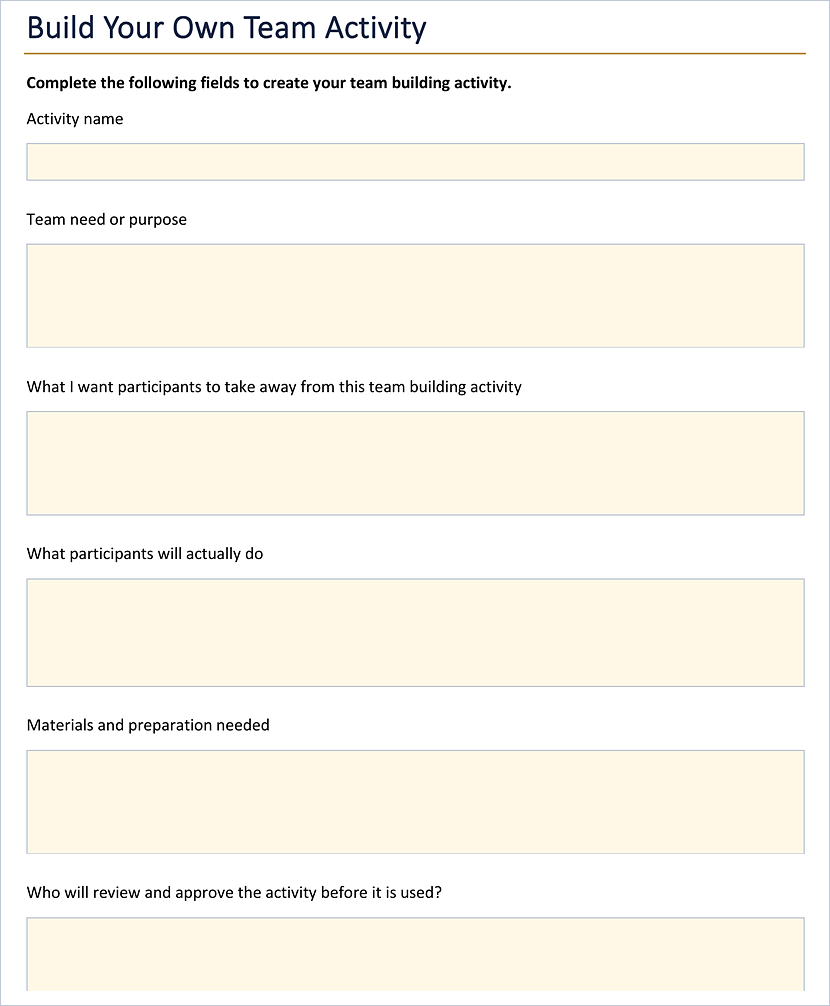
- Set the stage. Pick one thing you want the team to experience or discover, give the activity a name, and introduce it without giving away the lesson.
- Create the experience. Give people something to solve, build, compare, or try together, with simple instructions and nobody put on the spot.
- Reveal the lesson. Ask what surprised people and what changed their thinking, and let their answers come before yours.
- Connect it to work. Ask where the same behavior or challenge shows up in the team's daily work.
- Make it stick. If the group finds a practical improvement, choose one small action and follow through. If it doesn't, the shared experience was enough.
Two worksheets hold your plan, one for designing the activity and one for leading it, along with a seven-question checklist to review before the meeting, such as "Will people experience something rather than simply listen?" Ask someone you trust to read it over first, because a fresh pair of eyes catches confusing directions and timing that won't work as intended.
It's also a good assignment for an employee who wants to grow as a leader. Let them design an activity, review and approve the plan, and consider letting them lead it.
Team Building Schedule Template
An activity that lives only in your head tends to get pushed aside by whatever's urgent that week, so put the next one on the calendar. One team building exercise a month as part of your regular team meeting is a reasonable rhythm.
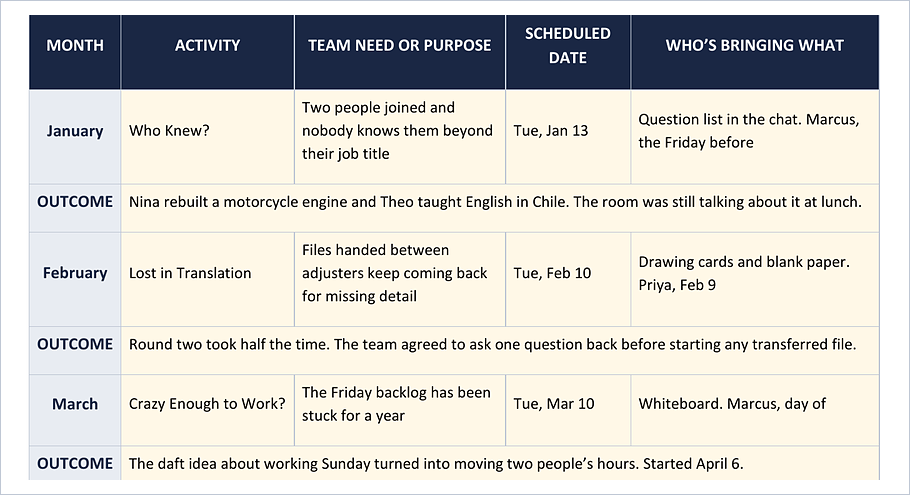
Using the team building activity scheduler, fill in the top line of each month with the planned activity, the team need it's meant to address, the date, and who's bringing what. After completing the activity with your team, write in the outcome, including anything you'd do differently next time. The scheduler template is on page 48 of the Leader's Guide.
| Month | Activity | Team need or purpose | Scheduled date | Who's bringing what |
| Month 1 | ||||
| OUTCOME | ||||
| Month 2 | ||||
| OUTCOME | ||||
| Month 3 | ||||
| OUTCOME | ||||
| Month 4 | ||||
| OUTCOME | ||||
| Month 5 | ||||
| OUTCOME | ||||
| Month 6 | ||||
| OUTCOME | ||||
Six-Month Team Building Schedule Example
Marcus Hale runs an eight-person claims team. Two people had joined in January, and files handed from one adjuster to another kept coming back missing details, so he built his first six months around what the team needed and filled in the outcome line within a day of completing each activity.
Keep It Simple. Schedule one activity at a time or map out several months. A good mix includes relationship-building, collaboration, creative thinking, accountability, and recognition.
Revisit the schedule whenever the team needs to change or improve on something. The purpose is to make team building an integral part of how you lead.
Five Mistakes That Waste a Team Building Activity
| Mistake | What to do instead |
| Picking the activity you like best | Choose by what your team needs right now. A new team may get more from Who Knew?, and a team whose handoffs keep coming back incomplete may get more from Lost in Translation. |
| Requiring people to share | Invite contributions and let anyone pass without explaining. Nobody should have to tell a personal story or rate themselves out loud, and a quiet teammate may have plenty to say after a minute to write it down first. |
| Using an activity to judge people | Keep team building out of tests and performance reviews. Scores on the Team Habits Self-Check stay with the person who wrote them. |
| Turning every activity into an action plan | Some activities succeed because people laughed together or learned something about a coworker. When the group does find an improvement, pick one small action and follow through on it. |
| Promising a fix you can't deliver | When an issue involves another team or needs approval, commit to looking into it and reporting back, then report back even when the answer is no. |
More on Team Building
Each of these pages looks at one part of building a stronger team. Pick the one closest to what your team is working on right now.
Accountability Team Building Activities
Activities that help a team keep its commitments to each other, with the setup, timing and follow-up for each one.

Leadership Team Building
Activities that build leadership skills in your team members, and the part you play as their leader in each one.

Fun Team Building Activities
Short games for a team meeting, such as Team Jeopardy and Pet Match, with small prizes that add energy.

Team Goal Setting
Six steps for setting a goal with your team and keeping it moving each week, plus two team goal setting activities.

Team Building Lesson Plan
A complete 60-minute session built from the activities on this page, from the objective and materials to the debrief and follow-up.
For games that teach a leadership lesson, the Leadership Games page has its own collection.
Frequently Asked Questions
The questions below address what leaders most commonly ask about our free team building activities.
Click on the (+) sign below to expand each question. Click the (-) sign to collapse it again.
What are free team building activities?
How long does a team building activity take?
Eight of the 12 activities take 25 minutes, and four take 30: The Missing Piece, Start, Stop, Continue, Team Battle Cry, and The Ripple Effect. Preparation is separate and runs 5 minutes for most of them, 5 to 10 minutes for The Way I Work and What Went Wrong?, and 10 minutes for The Missing Piece.
How many people do I need for these team building activities?
It depends on the activity. Several run in pairs, such as Lost in Translation and The Difference You Make, The Missing Piece uses groups of four to six, and others are whole-team discussions. For a large team, breakout groups give more people a chance to contribute, and each activity's instructions say how to arrange the group.
How often should we do team building activities?
One a month works for most teams, either inside a regular team meeting or in a meeting set aside for it. Monthly isn't a requirement, so adjust it to your team and your meeting schedule, and put the next one on the calendar before the current one slips off your radar.
What is a good team building activity for a new team?
Who Knew? is a good first choice, because people learn something about each other beyond their job titles and anyone can pass on a question. For communication problems, try Lost in Translation, and for appreciation, try The Difference You Make.
Can these team building activities work with a virtual team?
Yes. Every activity in the Leader's Guide includes a virtual version, using breakout rooms for pairs and small groups, the meeting chat or a shared document for ideas, and private messages for anything one person needs to see on their own, such as a drawing card or an Evidence Card.
Does every team building activity need an action plan?
No. Some activities produce an improvement worth acting on, and others work because people laughed together or learned something about a coworker. When the group does find a practical improvement, choose one small action and follow through without adding paperwork.
Can I create my own team building activity?
Yes. The Leader's Guide walks you through five steps, from setting the stage to making it stick, with two planning worksheets and a checklist to run before the meeting. It also works as a development assignment for an employee who wants to grow as a leader.
Is there a team building schedule template?
Yes. The six-month team building schedule template is on this page and on page 48 of the Leader's Guide. Each month has a line for the activity, the team need, the date, and who's bringing what, with an outcome line underneath, and page 49 shows a completed example.
Is the Team Building Activities Leader's Guide free?
Yes. The 50-page Leader's Guide is free to download in PDF, Word, and Google Docs, with no signup and no password.
Download Team Building Activities

Free Team Building Activities Leader's Guide:
The Leader's Guide includes the Fun Meeting Game Kit in the appendix, with printable sheets for the games on our fun team building activities page.
Want the entire leadership tools library? Subscribe to our free newsletter and we'll send you a link to every tool on this site, all on one page, sorted by leadership phase. Every tool is free to download on its own page. The library just puts them in one place. Plus, you'll never miss out on updated or new tool announcements.
Your privacy is important to us. We never share or sell email addresses.
Leadership Tools Newsletter
Subscribe Free - See All Tools on One Page - Get New Tool Alerts
More Leadership Tools for Managing Your Team



Richard Gorham has led teams in financial services for more than 30 years, from retail branches and operations to investments and insurance, and he still leads a team today.
He founded Leadership-Tools.com in 2002 to give managers free, practical tools like the ones he used in his various leadership roles. Every tool here has been used in a real workplace and comes with a filled-in example you can follow.

Contact Information:
phone
(503) 970-9777
Email Customer Service
helpsupport@leadership-tools.com
Email Richard
richard@leadership-tools.com

By Richard Gorham
Leadership-Tools.com
2879 Riverwalk Loop, Eugene, Oregon, 97401
Copyright (c) 2002 - 2026 All Rights Reserved